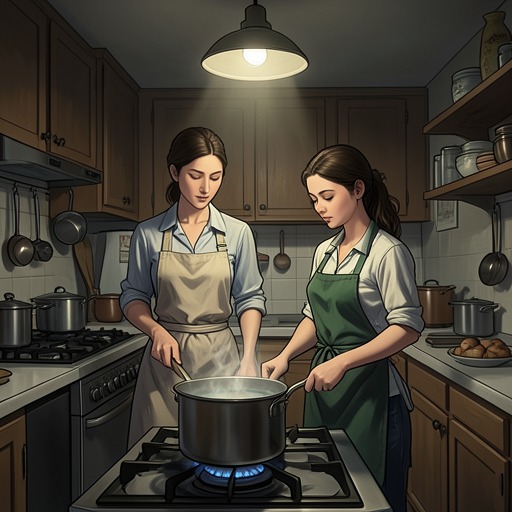
Tita and Rosaura’s confrontation over Esperanza
Like Water for ChocolateTita and Rosaura’s confrontation over Esperanza is a direct collision between family duty and a woman’s right to choose her own life. In the kitchen, an argument that begins with their history around Pedro becomes a dispute over access to Esperanza: Rosaura claims the authority to exclude Tita, while Tita refuses to accept that the family’s inherited rule should govern the child’s future.
Background and Stakes
The sisters’ conflict rests on two connected injuries. Tita and Pedro had loved one another, but Tita’s place as the youngest daughter meant that she was expected to remain unmarried and care for her mother. Rosaura invokes that family tradition to argue that Tita had no right to a boyfriend. Tita counters that the rule did not entitle Rosaura to stand between two people who loved each other. In their exchange, Tita says Pedro married Rosaura so that he could stay near her; Rosaura rejects the importance of his motive and insists that the marriage itself gives her a claim that Tita must respect.
By the time of the confrontation, Esperanza’s future makes the old dispute immediate. Rosaura is Esperanza’s mother, but Tita has been closely involved in the child’s care. The family’s youngest-daughter custom threatens to make Esperanza responsible for caring for Rosaura throughout her life. Rosaura’s childbearing had ended with an emergency operation, leaving Esperanza her only child; because the child was also a girl, the inherited expectation could fall on her. Tita opposes passing that obligation on, so the argument concerns not only the sisters’ past but the life Rosaura expects her daughter to lead.
The Kitchen Confrontation
Rosaura opens the discussion while Tita quietly breaks the ends from the tortillas they have eaten, preparing to feed the scraps to the chickens. The domestic routine continues as the sisters face one another. Tita does not let Rosaura’s appeal to tradition settle the question: she says she will break with the rule again if it continues to disregard her, and asserts that she had the same right to marry as Rosaura.
The argument also exposes what Rosaura understands about Tita and Pedro. Rosaura says she has seen them behave affectionately in public and knows they meet in private. She is less concerned with whether Pedro’s feelings for her are genuine than with the humiliation she fears if their relationship becomes visible to others. She insists that she will remain his wife in the household and in public, and warns that Tita and Pedro must keep their relationship concealed. Her position makes respectability and the appearance of an intact marriage part of the dispute, not merely private hurt between sisters.
When Esperanza’s crying grows louder, Rosaura announces that she will feed her daughter herself and forbids Tita from feeding the child again. She presents Tita as a harmful influence, while Tita answers that she will not allow Rosaura to impose the same restrictive ideas on Esperanza. The disagreement thus shifts from their competing accounts of the past to an immediate contest over caregiving and influence. Rosaura threatens to keep Tita away from Esperanza and, if necessary, drive her from the house that she says Mama Elena left to her.
Immediate Consequences
Rosaura leaves the kitchen to feed Esperanza, taking the mush Tita had prepared. The act gives force to her warning: for the moment, she has removed Tita from the child’s care. Tita is especially hurt because Esperanza is among the people she loves most. She continues breaking the tortilla into tiny pieces, then takes the scraps outside for the chickens before returning to prepare the beans. Esperanza’s white diapers, embroidered by the family and hanging on the lines, remain in view as Tita tries to put the child’s absence from her care aside and resume her work.
The confrontation does not immediately settle either sister’s claim. Rosaura maintains her position as mother and wife; Tita refuses to treat the family rule as legitimate simply because it is inherited. Their conflict over Pedro is therefore joined to a struggle over Esperanza’s daily care, education, and eventual freedom to marry. The kitchen scene gives those larger stakes a concrete form: who feeds the child, who may guide her, and who has the authority to decide what her future will be.
Later Agreements and Significance
In a later arrangement, Tita, Pedro, and Rosaura preserve the public appearance of a normal family while allowing Tita a continuing role in Esperanza’s life. Tita and Pedro agree to keep their relationship secret and not have a child together; Rosaura, in turn, agrees that Tita may feed Esperanza while Rosaura oversees her education. The terms do not erase the earlier confrontation. They instead show how the sisters’ conflict becomes an uneasy division of authority, with care and instruction assigned separately.
Rosaura resists sending Esperanza to school, arguing that the child’s expected duty to her mother makes further study unnecessary. Tita and Pedro press for her education, and Rosaura eventually consents after being persuaded that school will also help Esperanza move within Piedras Negras society. Tita supplements that formal education by teaching her what the kitchen can convey about love and life. When Esperanza later wishes to marry Alex Brown, Rosaura again opposes the prospect that her daughter will leave her; Tita and Pedro support Esperanza’s choice. After Rosaura’s death, Tita’s success in helping bring about the wedding becomes a decisive reversal of the future Rosaura had tried to secure. The earlier kitchen confrontation anticipates that outcome: Tita’s resistance is not only a defense of her own past with Pedro, but also a refusal to let the family’s inherited rule dictate Esperanza’s adult life.